
Summer is in full swing, and so is the night sky this week! This is one of my favorite times of year to spend a few quiet minutes outside after sunset. If you can battle the mosquitoes for a little while, grab a lawn chair, lean back, and enjoy the show. Plenty is happening overhead this week.
🌙 Evening Highlights
Venus is the star of the show this week. It shines so brilliantly that it’s often the very first “star” you’ll notice as the sky begins to darken. Look toward the western sky after sunset, and you’ll have a hard time missing it.
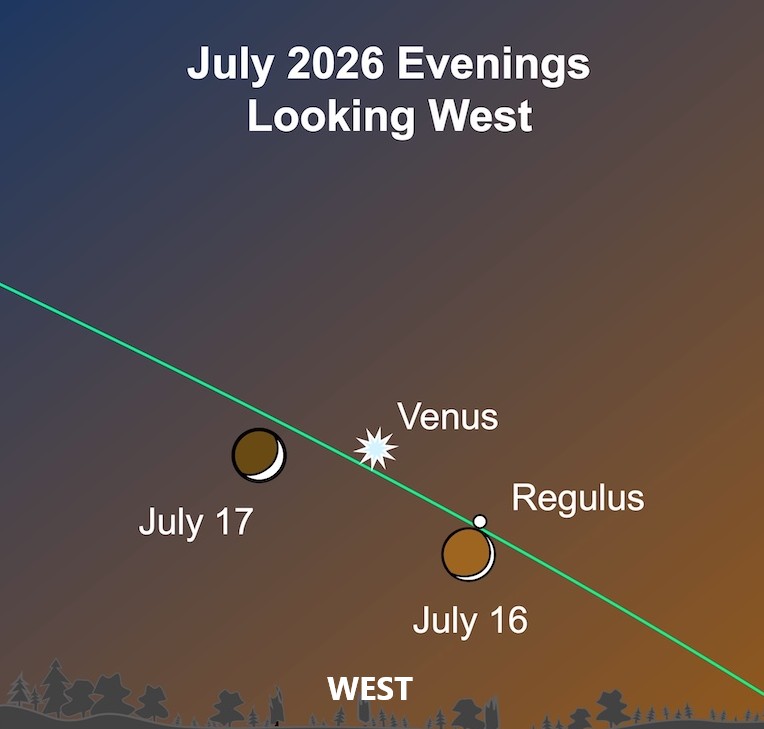
By Friday evening, the Moon will have moved just south of Venus. Watch the two slowly sink toward the western horizon together after sunset. It’s a beautiful way to end the day.
🌅 Early Morning Sky
If you’re an early riser, don’t miss the morning sky—it has plenty to offer.
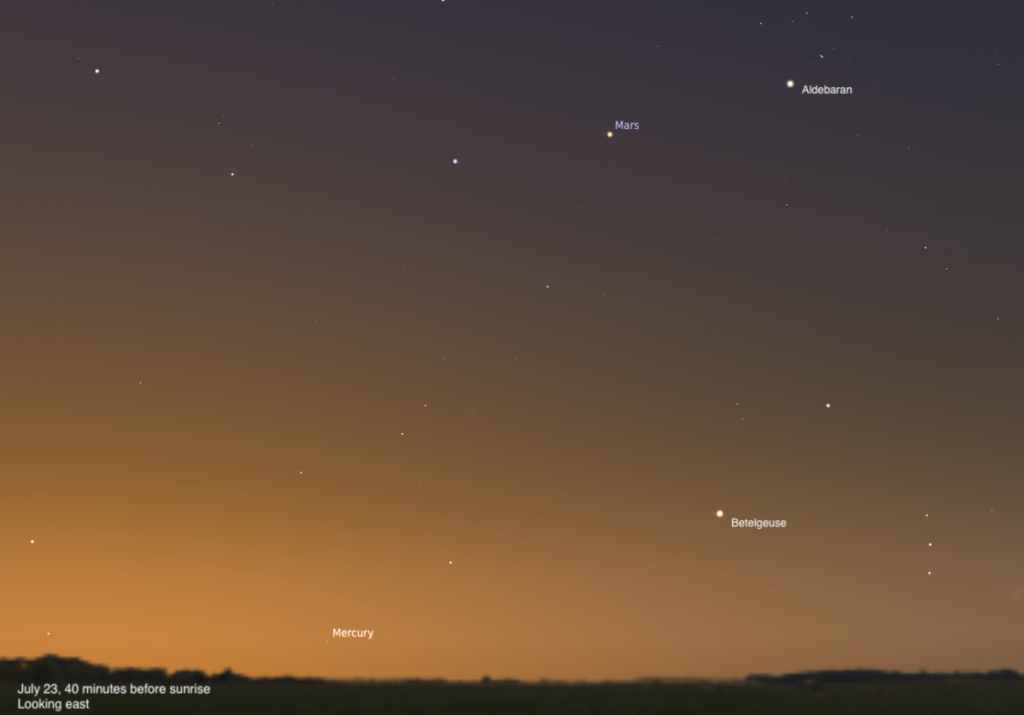
Mercury is making a brief appearance low on the eastern horizon this week. Look about 40 minutes before sunrise, before the sky becomes too bright. Since Mercury stays close to the horizon, a pair of binoculars will make it much easier to spot.
Saturn rises a couple of hours after midnight. Its steady golden glow makes it easy to distinguish from the twinkling stars around it, and it’s the brightest object in that part of the sky. If you have a small telescope, you’re in for a treat. Saturn’s famous rings are becoming more favorably tilted toward Earth, making the coming months an excellent time for viewing.
Mars rises about an hour before sunrise. The Red Planet sits just below the beautiful Pleiades star cluster, often called the Seven Sisters. Through binoculars, the contrast between reddish Mars and the sparkling blue-white stars of the cluster is especially striking.
Look a little higher and to the left of Mars to find Aldebaran, the bright orange star that marks the eye of Taurus the Bull. Its warm orange color creates a beautiful contrast with Mars’ reddish glow.
Between Aldebaran and the Pleiades lies the distant planet Uranus. It’s much fainter than the other planets, so binoculars will probably be needed to spot its subtle greenish tint.
✨ Constellations of the Week
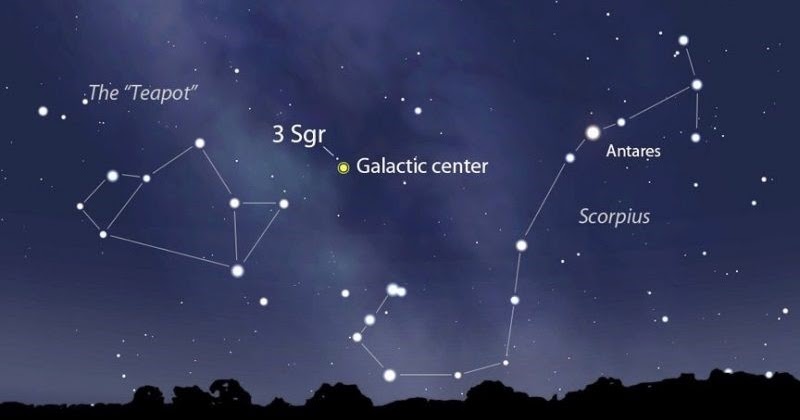
One of the unmistakable signs of summer is Scorpius climbing into the southeastern sky. This impressive constellation resembles a giant scorpion stretching across the horizon, complete with curved claws and a long sweeping tail.
Its brightest star, Antares, shines with a rich reddish-orange color that has fascinated skywatchers for thousands of years. In fact, the name Antares means “rival of Mars” because its color is so similar to the Red Planet. Ancient observers often mistook one for the other.
Greek mythology tells us that Scorpius was the giant scorpion sent to defeat the mighty hunter Orion. To keep them forever apart, Zeus placed them on opposite sides of the sky. As Scorpius rises on warm summer evenings, Orion is setting—or already below the horizon—ensuring the two celestial rivals never meet.
Just east of Scorpius is Sagittarius, the Archer. While mythology depicts it as a centaur drawing a bow, most people today recognize its famous “Teapot” shape. Once you spot the Teapot, you’ve found one of the richest regions of the night sky.
The “steam” rising from the Teapot points directly toward the brightest part of the Milky Way. As the sky grows darker, our galaxy stretches across the southeastern sky like a soft, glowing river of light. If you’re away from city lights, it’s one of the most breathtaking sights of summer.
That hazy band isn’t a cloud at all—it’s the combined light of billions of distant stars in our own galaxy. The brightest section lies near Sagittarius because that’s the direction we’re looking toward the center of the Milky Way, about 26,000 light-years from Earth. Hidden there are glowing nebulae, ancient star clusters, and some of the richest telescopic views anywhere in the night sky.

As darkness settles in, look nearly overhead for the Summer Triangle, one of the easiest star patterns to recognize. It’s formed by three bright stars—Vega in Lyra, Deneb in Cygnus, and Altair in Aquila. Once you find these three stars, they’ll guide you through the summer sky for the next several months. Even better, the Milky Way flows right through the triangle, making it a perfect starting point for exploring the heavens.
If you have a clear evening this week, take a few minutes to step outside and look up. You never know what might catch your eye. Whether it’s brilliant Venus shining after sunset, the glowing heart of Scorpius, or the Milky Way stretching overhead, summer nights have a special way of reminding us just how amazing our universe really is.
Happy stargazing! 🌠✨