
Night sky this week: The nights are getting longer here in South Dakota, giving us more time to enjoy the night sky. You don’t need a telescope or any fancy equipment to do a little stargazing. Just grab a lawn chair, bundle up in a warm jacket, and head outside. A clear evening can offer quite a show!
This week, keep an eye out for the Leonid meteor shower, known for fast-moving meteors and occasional long, bright trails. If you’re up early in the morning, there are also several planets worth looking for. Jupiter and Mars are sharing the morning sky, while Venus and Mercury are appearing closer to the eastern horizon. There’s plenty to keep an eye on!
🪐 Saturn Shines in the Night Sky this Week
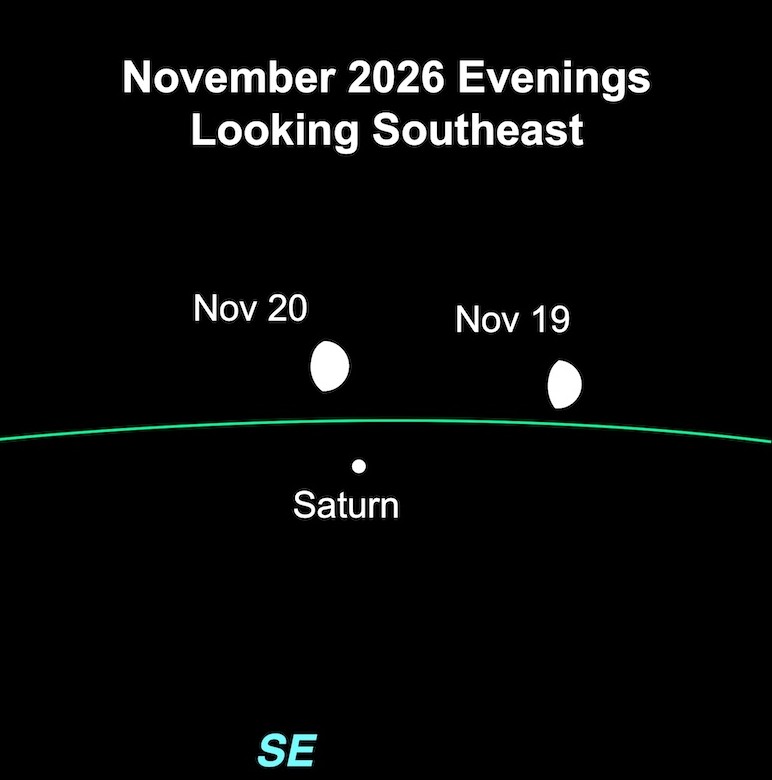
Saturn continues to be a nice sight in the evening sky. It rises in the east around sunset and remains visible for much of the night. By about 9:00 PM, look high in the southern sky for its steady, golden glow.
Saturn has a soft golden appearance that makes it fairly easy to pick out from the surrounding stars. If you have a telescope, this is a good time to take a closer look at the planet and its famous rings. Even a small telescope can make the experience special.
Saturn is currently in the constellation Cetus, also known as the Whale. Cetus sometimes comes up in discussions about the zodiac, but it isn’t one of the 12 traditional zodiac constellations.
Even without a telescope, Saturn is worth finding on a clear fall evening. It’s pretty amazing to think that the little golden point of light you’re looking at is actually a giant planet far out in our solar system!
On November 20, look for the waxing gibbous Moon near Saturn in the evening sky. This will be a nice way to finish out the week’s skywatching. Both should be visible without a telescope.
🌅 Early Morning: Look for Mars, Jupiter, Mercury, and Venus
If you’re an early riser, or happen to be awake before sunrise, there are several planets to look for in the eastern sky. Mars and Jupiter are putting on a nice morning display, while Venus and Mercury are making appearances closer to the horizon.
✨ Venus: The Bright Morning Planet
Venus is making its return to the morning sky, rising in the east before the Sun. It’s one of the brightest objects you’ll see, so it should be fairly easy to spot as long as you have a clear view of the horizon.
☿ Mercury: The Little Planet
Mercury is another planet to watch for in the morning. About an hour before sunrise, look very low along the eastern horizon. Mercury can be tricky to spot because it never strays very far from the Sun, and the brightening morning sky makes it harder to see.
Look for Mercury to the lower left of Venus. You’ll need a clear, unobstructed view of the horizon to have the best chance of finding it.
🔴 Mars: The Red Planet
Mars has a reddish-orange color that helps it stand out from the surrounding stars. It rises later in the night and climbs higher as morning approaches. Look for Mars above and to the left of Jupiter.
On November 15–16, Mars and Jupiter will appear especially close together in the eastern sky before sunrise. They will be less than two degrees apart, making them easy to compare. Look for reddish Mars beside brilliant white Jupiter.
🪐 Jupiter Lights Up the Morning Sky
Jupiter is another early morning favorite. Look toward the eastern sky before sunrise, where this bright planet stands out against the darker background. It’s usually one of the easiest planets to recognize without a telescope.
If you’re already outside looking for Mars, keep an eye out for Jupiter nearby. The two planets make a nice pair to compare, especially when you notice the difference in their brightness and color.
A pair of binoculars can make the view even more interesting, and a small telescope may reveal Jupiter’s four largest moons. Those little points of light are actually moons orbiting a giant planet millions of miles away!
☄️ The Leonid Meteor Shower in the Night Sky
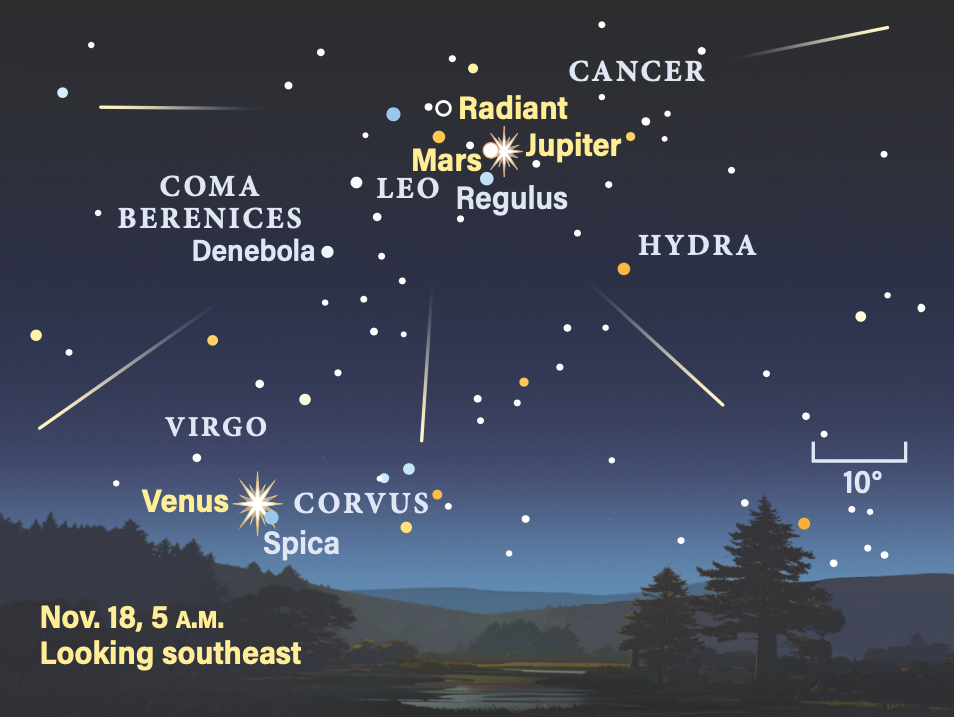
The Leonid meteor shower peaks overnight November 17–18, rather than simply Tuesday morning. The best view will be after midnight and before dawn on November 18. The Moon should set around midnight, leaving darker skies for meteor watching. Expect up to about 15 meteors per hour under ideal conditions. Find a dark spot away from porch lights and streetlights, give your eyes about 20 to 30 minutes to adjust, and get comfortable. No binoculars or telescope are needed. Just look up and enjoy the show in the night sky this week! The center of the shower is between Jupiter and Mars.