
Night sky this week, summer may still be bringing us plenty of heat, but the nights are slowly getting longer, and the first hints of fall are already on the way. That makes this a great time to spend a few minutes outside after dark and see what’s happening overhead.
🌙 Evening Sky: Venus Steals the Show in the Night Sky this Week
Venus continues to dominate the evening sky. It’s incredibly bright and will usually be the first planet, and often the first “star” you’ll notice after sunset.
Look toward the western sky shortly after sunset and watch for Venus as the sky begins to darken. Because it’s so bright, it’s easy to spot even from town. Venus is sometimes called the Evening Star, although it’s actually a planet and doesn’t produce its own light. The brightness comes from sunlight reflecting off its thick clouds.
Venus is also a fun planet to compare with the stars around it. Stars tend to twinkle because their light has to travel through Earth’s atmosphere, while planets usually shine with a steadier light. Once you notice the difference, you’ll start recognizing planets much more easily.
If you have a telescope, Venus can be especially interesting because, like the Moon, it goes through phases. Depending on its position relative to Earth and the Sun, you may see Venus looking like a tiny crescent or a small, nearly round disk.
🌅 Morning Planets
The real planetary lineup comes before sunrise this week, so if you’re an early riser, set the alarm a little earlier and take a look.
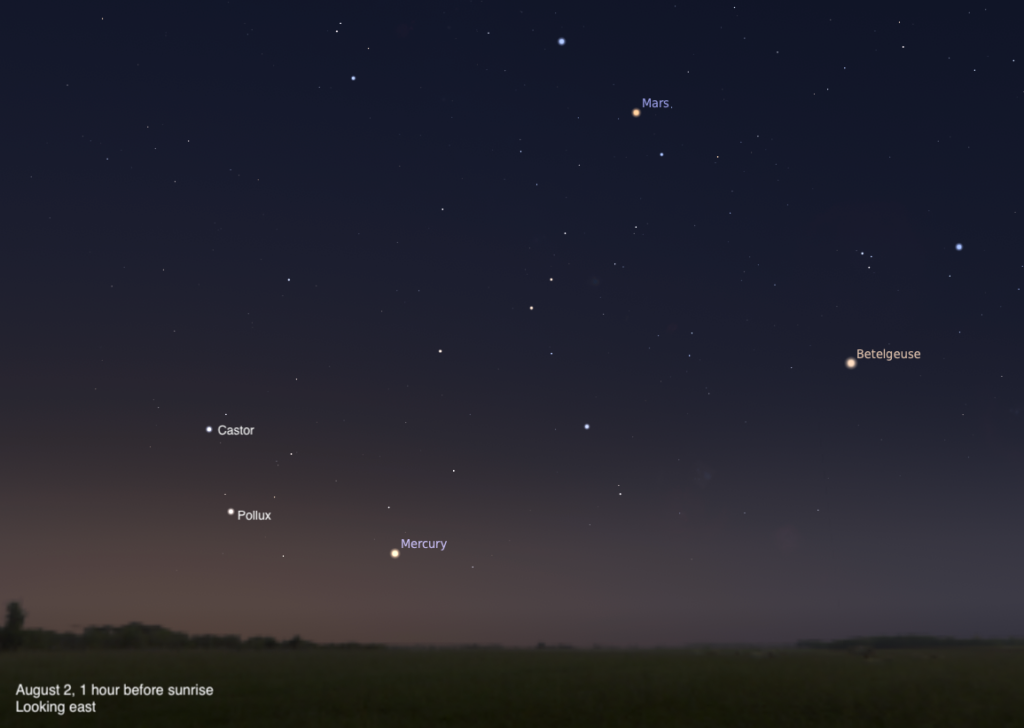
☿ Mercury: The Elusive Planet
Mercury makes a short appearance low in the eastern sky about an hour before sunrise. Look near Gemini, to the right of the bright stars Castor and Pollux.
Mercury is one of the more difficult planets to spot because it never strays very far from the Sun in our sky. That means there’s only a short window when it’s visible before sunrise or after sunset.
If you want to find it, choose a location with a clear, unobstructed view of the eastern horizon. Trees, buildings, and hills can easily hide this little planet.
Mercury is the smallest planet in our solar system and the closest planet to the Sun. Temperatures on its surface swing dramatically between scorching hot days and extremely cold nights because it has almost no atmosphere to hold onto heat.
🔴 Mars: The Red Planet
Look toward the upper right of Mercury to find Mars.
Mars isn’t nearly as bright as it was earlier this year, but its distinctive reddish-orange color makes it relatively easy to identify. The color comes from iron minerals in the planet’s surface that have essentially rusted over billions of years.
Mars is also home to several robotic explorers, making it one of the most closely studied worlds beyond Earth. When you look at that tiny reddish point before sunrise, you’re looking at another planet in our solar system that humans are actively exploring with spacecraft and rovers.
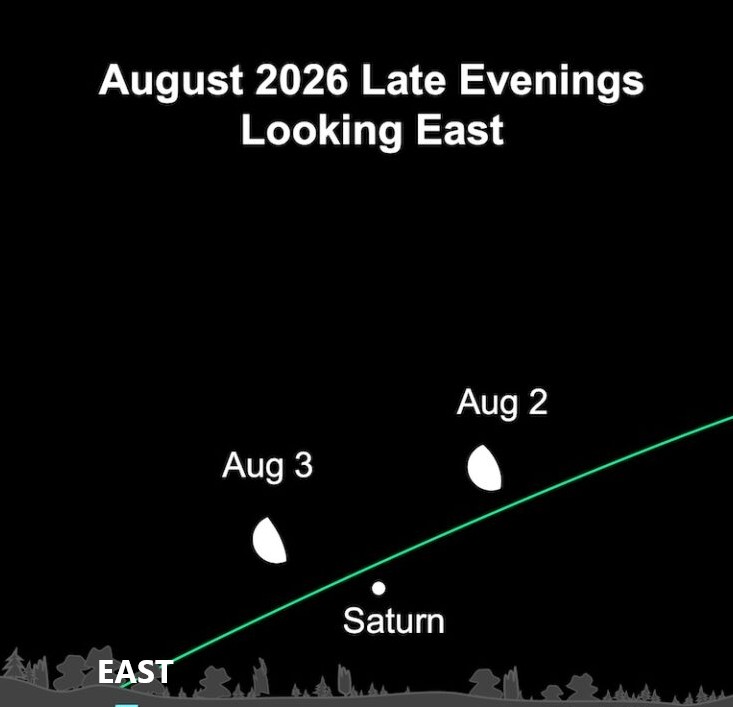
🪐 Saturn: The Ringed Wonder
Saturn is one of the highlights of the morning sky. It rises before midnight, so you don’t have to get up at an unreasonable hour to see it.
Look toward the southern sky during the early morning hours for a steady, yellowish-golden point of light. Saturn doesn’t twinkle as much as the stars around it, making it fairly easy to recognize once you know where to look.
Saturn’s magnificent rings are becoming more favorably tilted toward Earth, giving us nice views of this famous feature. Even a small backyard telescope can reveal the rings, and under good conditions you may even be able to make out Saturn’s largest moon, Titan.
Saturn is enormous compared with Earth — more than 750 Earths could fit inside it by volume. Yet the planet is mostly hydrogen and helium and is actually less dense than water. If you could somehow find a bathtub big enough, Saturn would float!
🟢 Uranus: A Challenge for Binoculars
If you’re looking for a little more of a challenge, try finding Uranus.
It’s located between Aldebaran and the Pleiades star cluster, although you’ll probably need binoculars to have much chance of spotting it. Uranus is far too faint to stand out like Venus, Mars or Saturn.
Through binoculars, Uranus may appear as a tiny, subtle blue-green point of light. Don’t expect to see a large disk — it’s a distant world more than 1.6 billion miles from the Sun.
Uranus is also an unusual planet. It rotates on its side, with its axis tilted about 98 degrees. Scientists think a massive collision early in the planet’s history may have caused this extreme tilt.
And here’s a fun fact: Uranus has rings, too! They’re much fainter and harder to see than Saturn’s famous rings, but they’re there.
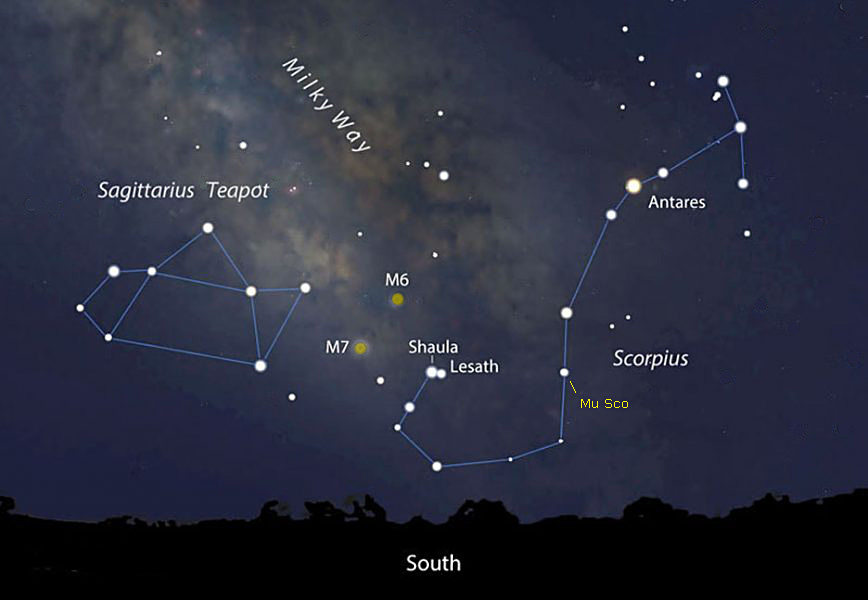
✨ Constellation of the Week: Scorpius
One of the unmistakable signs of summer is Scorpius climbing into the southeastern sky. It really does look like a giant scorpion, with curved claws and a long, sweeping tail.
Its brightest star, Antares, has a beautiful reddish-orange glow. The name Antares actually means “rival of Mars,” because ancient skywatchers noticed how similar the two looked in color.
Greek mythology has a story for Scorpius, too. According to the legend, the giant scorpion was sent to defeat the mighty hunter Orion. Zeus eventually placed them on opposite sides of the sky so they would never meet again. That’s why when Scorpius is rising on summer evenings, Orion is already below the horizon.
Just east of Scorpius you’ll find Sagittarius, the Archer. While the constellation is supposed to represent a centaur with a bow, most of us probably recognize its stars as something much simpler — the Teapot.
Once you find the Teapot, look for the “steam” rising from its spout. That points toward one of the richest parts of the night sky — the Milky Way.
🌌 Look Toward the Milky Way
As the sky gets darker, the Milky Way stretches overhead like a faint, hazy river of light. If you can get away from town and find a spot with little light pollution, it’s one of the most spectacular sights of a summer night.
And that hazy band isn’t a cloud. It’s the combined light of billions of stars in our own galaxy.
When we look toward Sagittarius, we’re looking in the direction of the center of the Milky Way, about 26,000 light-years away. Hidden in that region are glowing nebulae, ancient star clusters, and countless other objects that can be explored with binoculars or a telescope.
So, if you get a clear evening this week, grab a lawn chair and spend a few minutes looking up. Whether you’re watching brilliant Venus after sunset, finding Saturn before midnight, spotting Mars and Mercury before sunrise, or taking on the challenge of finding distant Uranus, there’s plenty to see.
And if you happen to get away from the town lights, don’t forget to look up at the Milky Way, too. Summer nights have a wonderful way of reminding us just how incredible our universe really is. 🌠
4 comments for “🌌 Night Sky This Week: Through August 7, 2026”