
Night sky this week: Summer may still be bringing us plenty of heat, but the nights are slowly getting longer, and the first hints of fall are already on the way. That makes this a great time to spend a few minutes outside after dark and see what’s happening overhead.
You don’t need an expensive telescope to enjoy the night sky. A comfortable lawn chair, a clear evening, and a little patience are often all you need!
🌙 Evening Sky: Venus & Saturn

Venus is one of the easiest planets to spot this week. Look toward the western sky about an hour after sunset. Venus will appear as a bright, unmistakable point of light against the fading twilight.
As Venus gradually sinks lower toward the horizon, it will continue getting brighter, reaching its greatest brilliance next week. If you have a clear view of the western horizon, this is a great opportunity to see one of the brightest objects in our nighttime sky.
Another highlight is Saturn. It rises at about 9 PM local time, making it much easier to see than planets that require getting up in the middle of the night. It is not hard to spot, being the brightest object in the area.
Saturn’s magnificent rings are becoming more favorably tilted toward Earth, giving backyard skywatchers a particularly nice opportunity to see them. Even a small telescope can reveal Saturn’s famous rings, and under good viewing conditions, you may even be able to spot Titan, Saturn’s largest moon.
🌅 Morning Sky: Mars & Jupiter

If you’re willing to set the alarm a little earlier, the morning sky has some great sights of its own.
Mars rises around 2 AM in the constellation Gemini. Mars isn’t nearly as bright as it will eventually become, but its distinctive reddish-orange color makes it relatively easy to identify.
That rusty color isn’t just your imagination. Mars gets its reddish appearance from iron minerals in its surface material that have oxidized — essentially, they have rusted — over billions of years.
Mars will gradually become brighter as Earth and Mars move closer together in their respective orbits.
Jupiter rises later in the morning, before sunrise. On September 8, look for the crescent Moon positioned above Jupiter, creating a beautiful pairing in the early morning sky.
If you have binoculars or a telescope, Jupiter is especially rewarding. You may even be able to spot some of its four largest moons, known as the Galilean moons.
✨ Constellations of the Week: Sagittarius and Scorpius
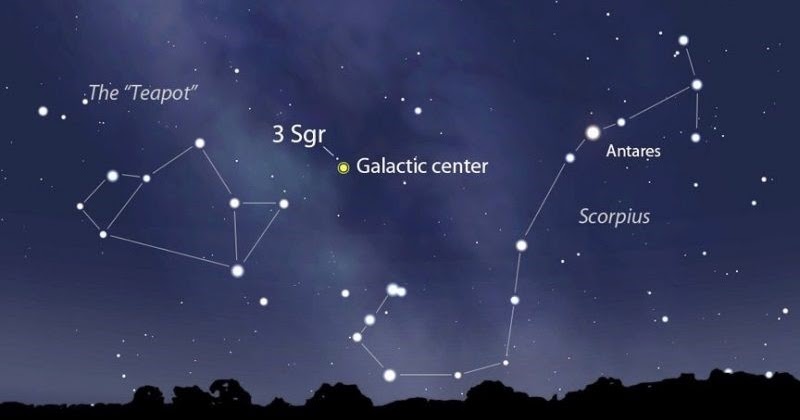
One of the unmistakable signs of summer is Scorpius climbing into the southeastern sky. It really does look like a giant scorpion, with curved claws and a long, sweeping tail.
Its brightest star, Antares, has a beautiful reddish-orange glow. The name Antares actually means “rival of Mars,” because ancient skywatchers noticed how similar the two looked in color.
Greek mythology has a story for Scorpius, too. According to legend, the giant scorpion was sent to defeat the mighty hunter Orion. Zeus eventually placed them on opposite sides of the sky so they would never meet again. That’s why when Scorpius is rising on summer evenings, Orion is already below the horizon.
Just east of Scorpius you’ll find Sagittarius, the Archer. While the constellation is supposed to represent a centaur with a bow, most of us probably recognize its stars as something much simpler — the Teapot.
Once you find the Teapot, look for the “steam” rising from its spout. That points toward one of the richest parts of the night sky — the Milky Way.
🌌 Look Toward the Milky Way
As the sky gets darker, the Milky Way stretches overhead like a faint, hazy river of light.
If you can get away from town and find a location with little light pollution, take some time to simply look up. The difference between a dark rural sky and a sky affected by city lights can be amazing.
And that hazy band isn’t a cloud.
It’s the combined glow of billions of stars in our own galaxy.
When we look toward Sagittarius, we’re looking in the general direction of the center of the Milky Way, approximately 26,000 light-years away. Hidden in that region are glowing nebulae, ancient star clusters, and countless other objects that can be explored with binoculars or a telescope.
For an even better view, give your eyes 15–20 minutes to adjust to the darkness. Avoid looking at bright phones or flashlights during that time. Your eyes will gradually become much more sensitive to faint objects.
☄️ Two More Reasons to Look Up
There’s another reason to step outside this week: the New Moon arrives around September 10–11. With the Moon contributing very little light to the night sky, this creates some of the darkest skies of the month, perfect for stargazing.
If you can get away from town lights, this is an especially good time to look for the Milky Way, along with star clusters and other faint objects that are difficult to see when the Moon is bright.
And keep an eye out for a few shooting stars around September 9 and 10. The Epsilon Perseid meteor shower reaches its peak during this time. It’s a relatively minor shower, so don’t expect a meteor storm, but under a dark South Dakota sky you may catch several meteors streaking across the sky.
The best way to watch? Find a comfortable spot, let your eyes adjust to the darkness, and simply look up. You don’t need a telescope — just patience and a clear view of the sky.
🔭 A Great Week to Look Up
So, if you get a clear evening this week, grab a lawn chair and spend a few minutes looking up.
Watch brilliant Venus after sunset. Look for Saturn later in the evening. Set an early alarm to find Mars and Jupiter in the morning sky and take advantage of the Moon’s close encounter with Jupiter on September 8.
And if you happen to get away from the town lights, don’t forget to look for the Milky Way stretching across the sky.
Summer may be winding down, but the night sky is giving us plenty of reasons to stay outside just a little longer.
🌠 Clear skies and happy stargazing!
1 comment for “🌌 Night Sky This Week: Through September 11, 2026 🌠”