
Summer is beginning to settle into the night sky this week, and this is one of my favorite times of year to spend a few quiet minutes outdoors after sunset. The evenings are warm, the days are long, and the stars seem to invite us to slow down for a while. Whether you enjoy identifying constellations or simply like watching the sky change from week to week, plenty is happening overhead.
🌙 Evening Highlights

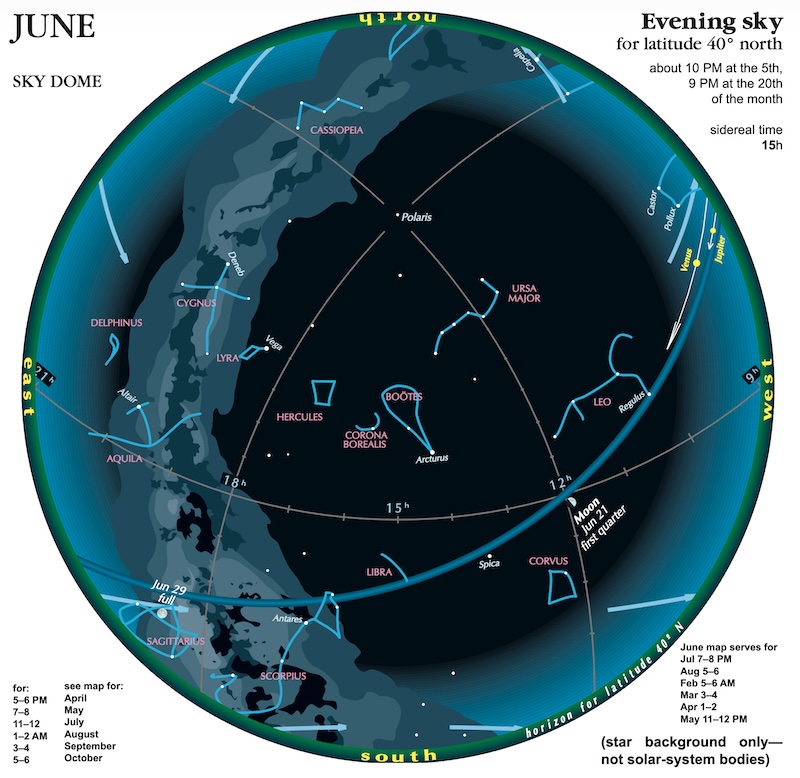
Monday evening (June 29) brings the Full Strawberry Moon. Despite its name, the moon won’t appear pink or red. The name comes from Native American tribes, who used it to mark the short strawberry harvest season in early summer. The full moon rises around sunset in the constellation Sagittarius, creating a beautiful sight as it climbs above the southeastern horizon. A full moon rising through the haze near the horizon often appears larger than it really is—a fun optical illusion known as the “Moon Illusion.”
Mercury makes a brief appearance in the evening sky this week. It remains low in the western sky after sunset and doesn’t stray far from the Sun, making it one of the more challenging planets to spot. Look for it shortly after sunset with a clear, unobstructed western horizon. Jupiter is nearby but fading quickly into the evening twilight.
Venus, however, steals the show. It shines so brilliantly that it’s often the very first object you’ll notice as the sky begins to darken. If you’re looking west after sunset, it’s nearly impossible to miss.
Venus has now passed Jupiter as it continues climbing higher in the evening sky. Since Venus orbits much closer to Earth than Jupiter does, it moves noticeably faster against the background stars. If you’ve been watching these two planets over the past few weeks, you’ve probably noticed their changing positions.
Jupiter is still visible for a short time after sunset before disappearing into the twilight. Even a modest pair of binoculars can reveal some of its greatest treasures—its four largest moons, discovered by Galileo in 1610. On different nights, these tiny moons line up differently as they orbit the giant planet, giving you something new to see each time you look.
🌅 Early Morning Sky
If you’re an early riser, the morning sky has plenty to offer.
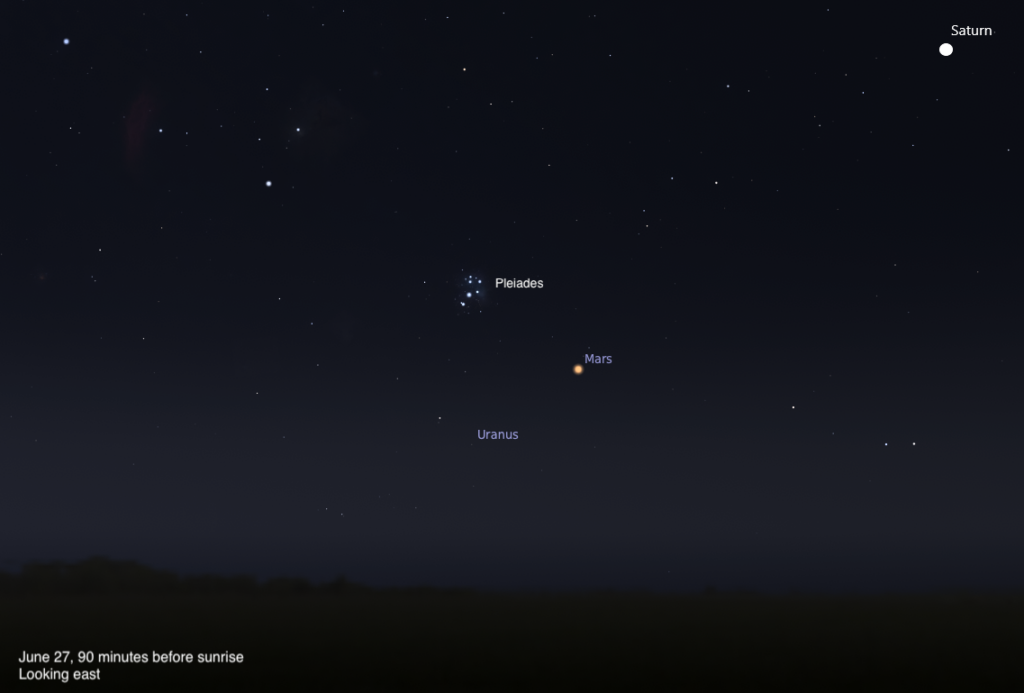
Saturn is becoming easier to spot in the southeastern sky before dawn. Its steady golden glow helps distinguish it from the surrounding stars, and it’s currently the brightest object in that part of the sky. Through a small telescope, Saturn’s famous rings are becoming more favorably tilted for viewing later this year.
Mars is also visible above the eastern horizon before sunrise. The Red Planet sits to the right of the beautiful Pleiades star cluster, sometimes called the Seven Sisters. The contrast between reddish Mars and the sparkling blue-white stars of the cluster makes for a beautiful sight with binoculars.
✨ Constellations of the Week
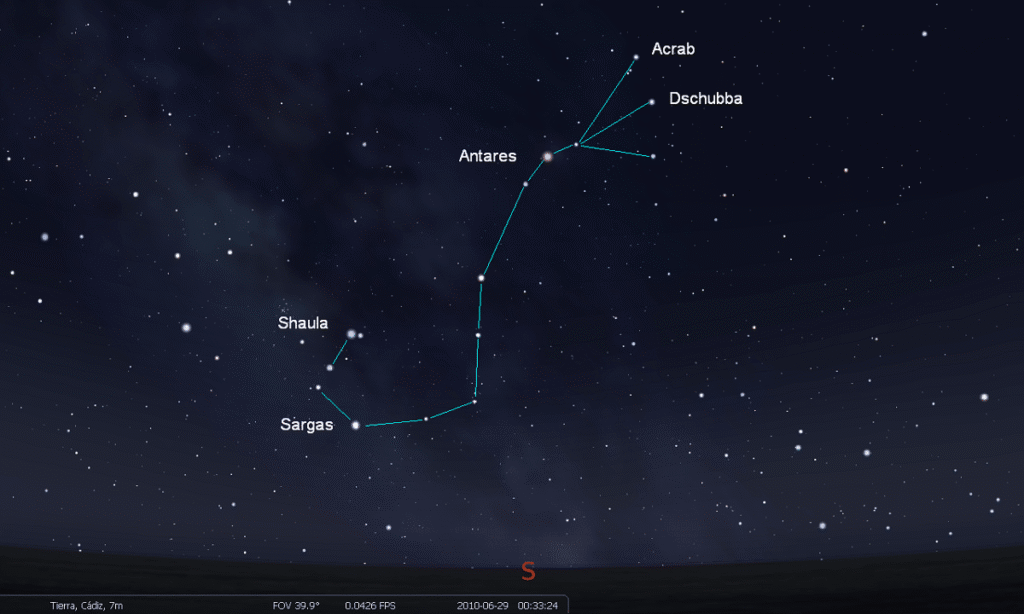
One of the unmistakable signs of summer is the arrival of Scorpius in the southeastern sky. This striking constellation resembles a giant scorpion stretching across the horizon, complete with curved claws and a long sweeping tail.
Its brightest star, Antares, glows with a deep reddish-orange color that has fascinated skywatchers for thousands of years. The name Antares means “rival of Mars” because its color is so similar to the Red Planet. Ancient cultures often mistook one for the other.
In Greek mythology, Scorpius was the giant scorpion sent to defeat the mighty hunter Orion. According to the legend, Zeus honored both by placing them in the sky, but on opposite sides. As Scorpius rises in the east during summer evenings, Orion is setting or already below the western horizon, ensuring the two celestial rivals never meet again.
For skywatchers across the Northern Hemisphere, Scorpius has long been one of the classic constellations of summer. When its glowing red heart and graceful tail appear above the southeastern horizon, you know the season has truly arrived.
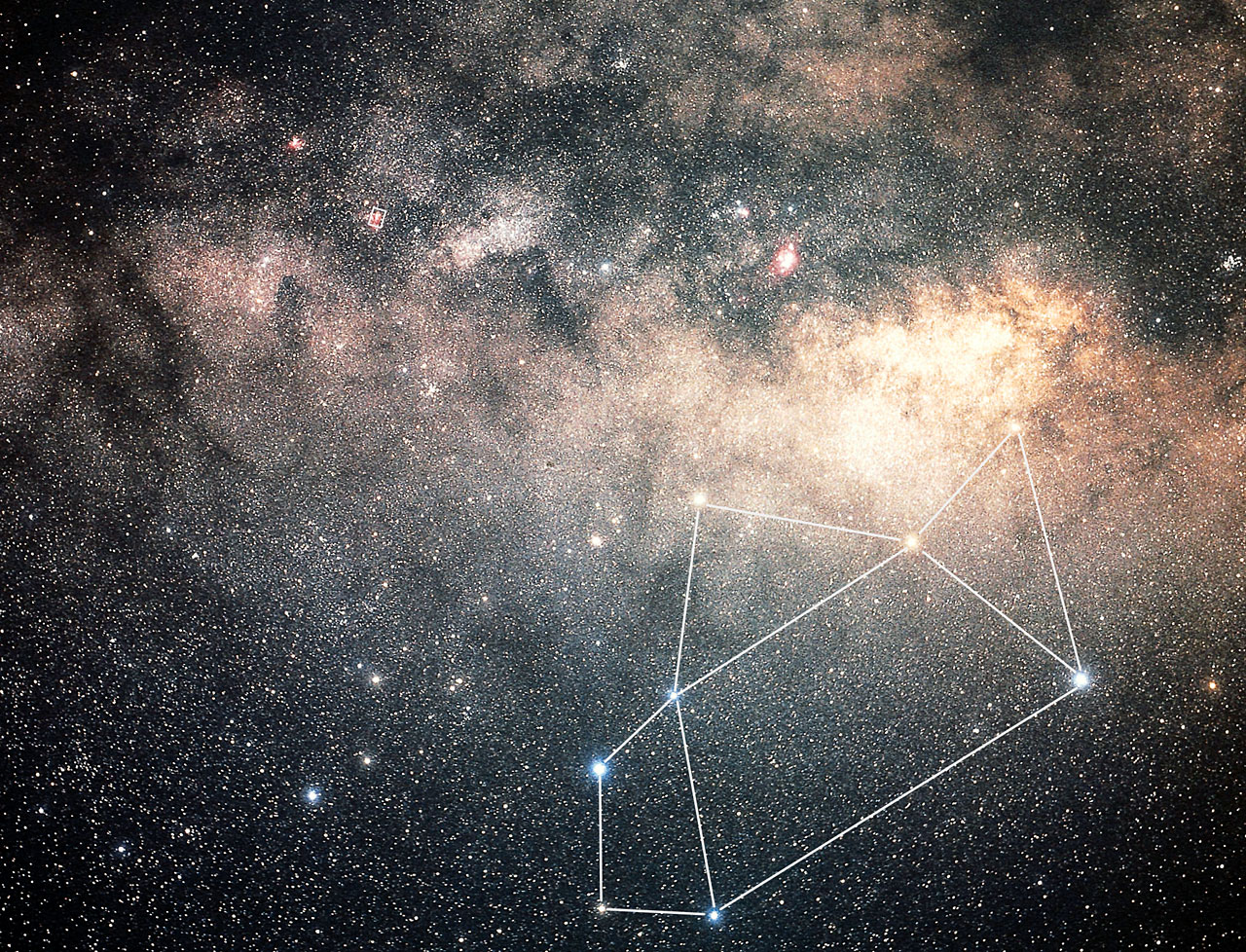
Just to the east of Scorpius is Sagittarius, the Archer. In mythology, Sagittarius is often shown as a centaur aiming his bow toward Antares. Today, many people find it easier to recognize the constellation’s famous “Teapot” shape instead.
If you can find the Teapot, you’re also looking toward one of the richest regions of the night sky. The “steam” rising from the teapot points directly into the brightest part of the Milky Way.
As darkness deepens, the Milky Way becomes increasingly noticeable, stretching across the southeastern sky. From a dark location away from city lights, you’ll see a soft, hazy band arching overhead. That faint glow is the combined light of billions of distant stars within our own galaxy.
The brightest section lies near Sagittarius because that’s the direction we’re looking toward the center of the Milky Way—roughly 26,000 light-years from Earth. Hidden among those countless stars are glowing nebulae, dense star clusters, and some of the richest telescopic views in the entire night sky.
If you get a clear evening this week, take a few minutes to step outside and look up. The night sky is changing quickly as spring gives way to summer. Bright planets, the rising Full Strawberry Moon, familiar summer constellations, and the glowing Milky Way all combine to make this one of the most rewarding times of year for stargazing.
You never know what might catch your eye, sometimes all it takes is a few minutes under the stars. 🌠✨
1 comment for “🌌Night Sky This Week: Through July 3, 2026 🌠”